

-
On November 11, 2026
Commercial Door Repair Example: A Smarter Fix
A shop door that needs a shoulder to close is more than an everyday annoyance. It can leave the property insecure after hours, frustrate customers, damage the frame, and create a safety concern for staff. This commercial door repair example shows how a seemingly minor issue at a busy storefront can point to several connected faults – and why a proper repair is often better value than a rushed patch.
The problem: a door that dragged, slammed, and would not lock
A small retail unit had an aluminum-framed glazed entrance door that had become progressively harder to use. Staff first noticed that the bottom edge caught the threshold on humid days. Within a few weeks, the door was scraping every time it opened, the closer was pulling it shut too aggressively, and the key would only turn after someone lifted the handle.
The owner initially assumed the lock was failing. That is an understandable conclusion, because locking the door had become the most obvious problem. But the lock was responding to a bigger alignment issue. The door had dropped slightly on its hinges, placing pressure on the latch and misaligning the multipoint locking points with their keeps in the frame.
This is common in commercial settings. A front entrance may be opened hundreds of times each week. Constant use, heavy door panels, loose fixings, worn pivots, seasonal movement, and an incorrectly adjusted closer can all affect how the door sits in its frame.
What a professional inspection revealed
The repair began with a full check of the door rather than a quick lock replacement. The technician tested the door open and closed, checked the gap around the frame, inspected the hinges and closer, and looked for damage around the threshold and locking points.
Three issues were found. First, the top hinge fixings had worked loose over time, allowing the door to sag. Second, the overhead closer was set with too much closing force and speed. That extra force was not the original cause of the drop, but it was worsening the strain on the hinges and making the door slam. Finally, the latch was no longer lining up cleanly with the strike plate, which explained why the key and handle felt stiff.
There was no major frame distortion and the glazed panel was sound. That mattered because it meant a targeted repair was realistic. If the frame had been twisted, heavily corroded, or pulling away from the surrounding structure, replacement might have been the safer long-term choice.
Why replacing the lock first would not have solved it
Fitting a new lock into a misaligned door can offer a short-lived improvement at best. The new mechanism still has to fight against pressure created by a dropped door. It may become difficult to operate again, and forcing it can wear internal components prematurely.
The order of work matters: restore the door’s position, set the closer correctly, then test and fine-tune the locking system. This approach protects the hardware and gives the repair a much better chance of lasting.
The commercial door repair work
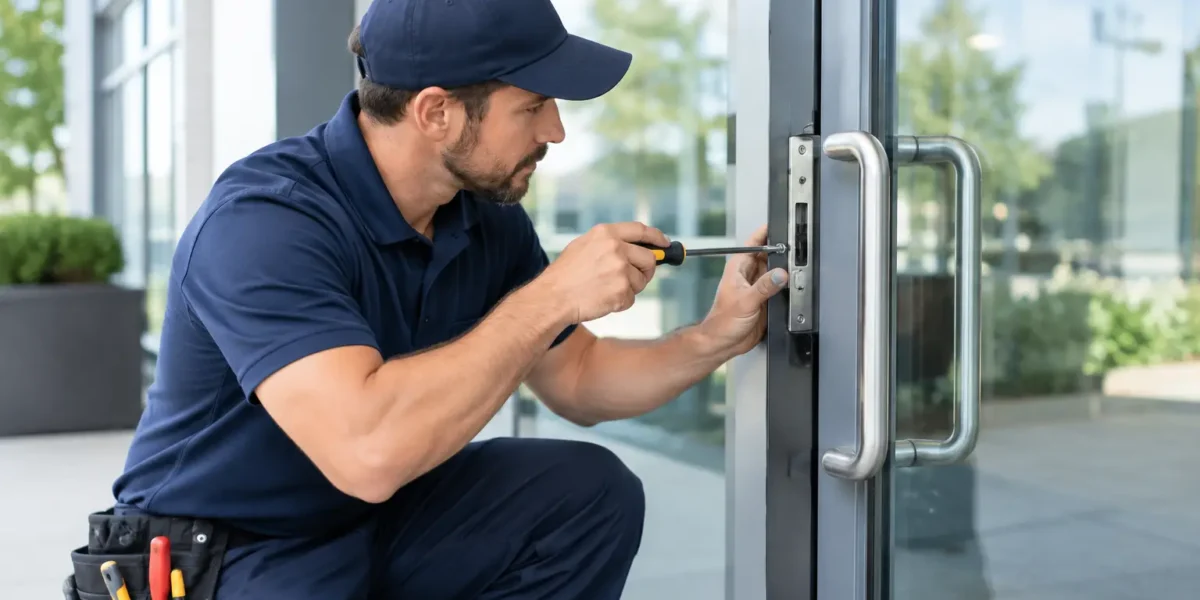
The technician supported the door, adjusted its position, and secured the hinge fixings. Where fixings no longer held firmly, they were replaced with suitable heavy-duty alternatives. The door was then aligned so it cleared the threshold evenly and sat squarely against the frame.
Next came the door closer. Closing speed and latching action were adjusted separately. The aim was not to make the door close as fast as possible. It needed to shut firmly enough to engage the latch and support security, without slamming into the frame or becoming difficult for customers to open.
Once the door was aligned, the locking points were tested. Minor adjustments to the keeps allowed the latch and bolts to engage smoothly. The cylinder and handle were checked for signs of wear, but neither needed replacing. A light service and lubrication of the moving hardware completed the work.
The result was a door that opened smoothly, closed in a controlled way, and locked without lifting, pushing, or forcing the handle. For the business owner, that meant a secure closing routine and fewer interruptions for staff. For visitors, it meant a professional entrance that did not stick, scrape, or slam.
Repair or replacement? It depends on the cause
Commercial door repair is often a practical, cost-effective option when the door panel and frame are fundamentally sound. Alignment adjustments, hinge repairs, closer servicing, replacement handles, fresh cylinders, and new weather seals can extend the usable life of a well-made entrance.
Replacement becomes more sensible when there is significant structural damage, recurring corrosion, cracked glazing, a severely warped panel, or outdated hardware that cannot provide the needed level of security. A door that has been repaired repeatedly may also cost more in downtime and callouts than a planned replacement.
For landlords and small business owners, the key question is not simply, “Can this be fixed?” It is, “Will this repair restore safe, dependable use for a reasonable period?” An honest assessment should explain both the immediate fix and any likely future work.
Signs your commercial entrance needs attention
Do not wait until the door will not lock at all. Early action can prevent damage to the lock, closer, hinges, frame, and threshold. Arrange an inspection if the door begins scraping the floor, needs force to open or shut, bangs closed, has a loose handle, or leaves visible gaps when closed.
Other warning signs include a key that sticks, a latch that misses the strike plate, drafts around the edges, water entering beneath the threshold, or customers struggling to use the entrance. On a glazed door, cracked glass, failed seals, or movement in the panel should be treated as a priority.
A fire-rated door needs particular care. Never make unapproved alterations or fit unsuitable hardware to solve a closing issue. Its closer, seals, hinges, and latch work together to support its fire performance, so repairs should be carried out with the door’s specification in mind.
How to keep a repaired door working longer
Most commercial entrance problems develop gradually, so simple routine checks can make a real difference. Staff can report a change in closing action before it becomes a lock failure. Keep the threshold clear of grit and debris, as dirt can increase wear and stop the door from sitting correctly. Avoid propping a self-closing door open unless an appropriate hold-open device is installed.
It is also wise to schedule periodic hardware checks for high-traffic entrances. Hinges, pivots, closers, handles, cylinders, panic hardware, and weather seals all have a working life. A planned adjustment or replacement is usually less disruptive than an urgent repair after a security failure.
For property owners in Manchester, Bee Manchester can assess doors, locks, glazing, and hardware as part of a practical repair plan. The goal is not to replace parts that still have life left in them. It is to identify the cause, make the right repair, and leave your entrance secure, safe, and buzzing with quality.
A commercial entrance is one of the hardest-working parts of a property. When it starts catching, slamming, or resisting the key, treat that change as useful early warning. A timely inspection can turn a frustrating daily fault into a straightforward repair before it affects security, access, or business trade.